Downsizing to 7,500 Square Feet
One must be comfortable describing the decision as refinement rather than reduction.
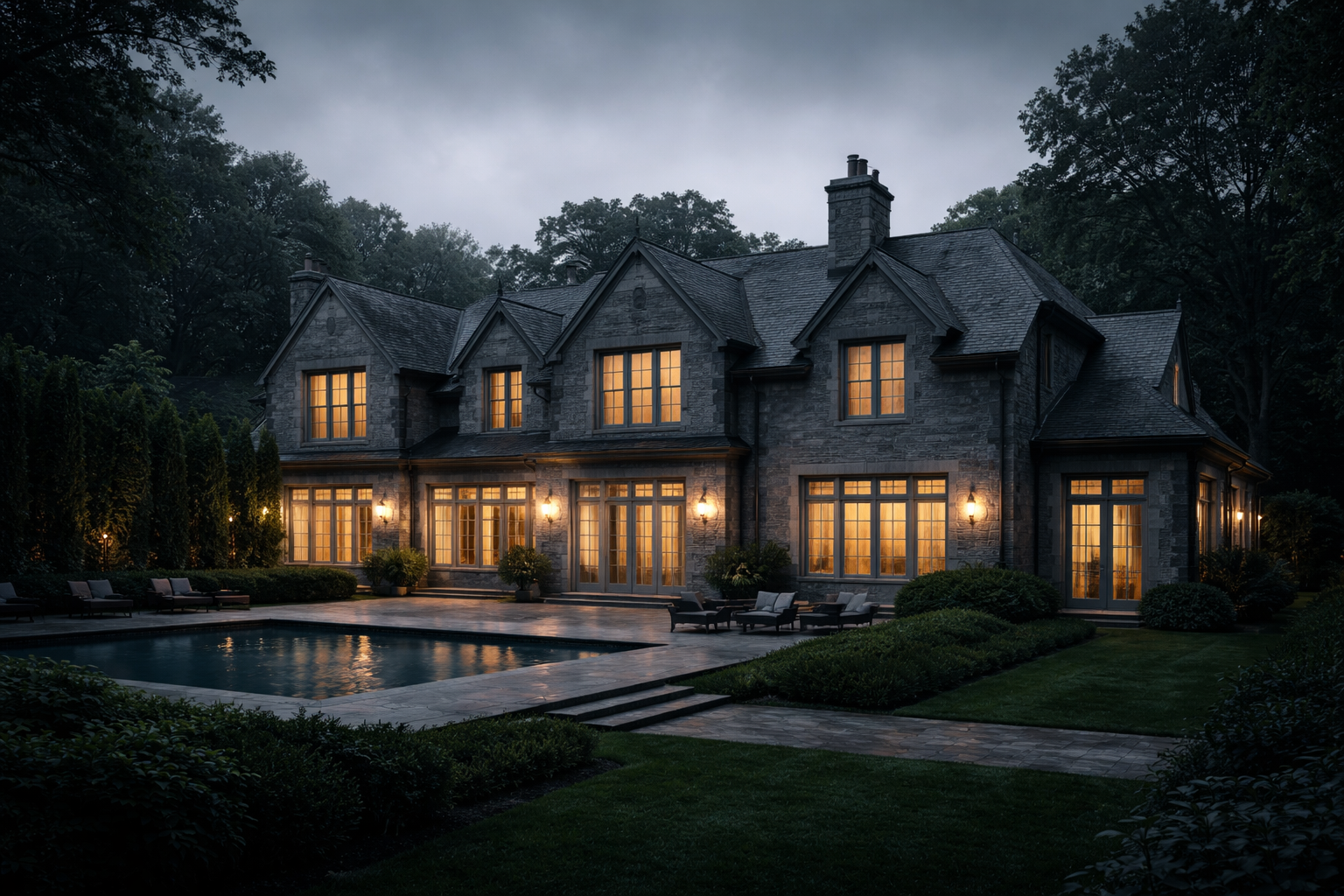
Downsizing is often discussed in terms of intention. Less frequently is it examined as a lived process, complete with its own frictions, compromises, and unexpected pressures.
For households accustomed to larger residences, the transition to 7,500 square feet introduces a series of adjustments that are not immediately apparent. The scale remains generous, but it is no longer forgiving. Decisions begin to matter.
At this size, a home stops absorbing excess automatically.
Rooms retain memory. Objects encounter one another repeatedly. Patterns of use become visible. What was once distributed now concentrates, and concentration brings its own challenges.
One of the earliest complications is spatial prioritization.
In larger homes, functions can coexist without negotiation. A room devoted to occasional use can remain untouched for months without consequence. At 7,500 square feet, every room is active. Every allocation carries opportunity cost. A secondary sitting area displaces storage. A music room competes with guest accommodations. Nothing is extraneous enough to ignore.
This can feel surprisingly constricting.
Storage, in particular, becomes an ongoing concern. While ample by conventional standards, storage at this scale demands selectivity. Seasonal rotation requires planning. Collections that once expanded freely must now be edited or externalized. The decision to store something offsite, however temporary, introduces logistical dependencies that can feel inelegant.
Closets begin to communicate.
They reveal patterns of acquisition that were previously dispersed across floors and wings. Redundancies become harder to justify when they share the same physical boundary. Even well-curated wardrobes can begin to feel compressed, not due to quantity, but proximity.
Entertaining also changes character.
A 7,500-square-foot home can host guests comfortably, but it cannot host them invisibly. Movement is more legible. Gatherings develop density. Hosts are required to remain present rather than delegating atmosphere to the building itself.
This creates a new form of social fatigue.
Guests arrive, settle, and remain perceptible. Conversations overlap. Circulation patterns intersect. The host’s awareness is continuously engaged. What once felt expansive now requires choreography.
Staffing expectations must also be reconsidered.
At larger scales, full-time support is structurally justified. At 7,500 square feet, the distinction between full-time and part-time assistance becomes ambiguous. Roles blur. Scheduling tightens. Coverage gaps are felt more acutely.
The absence of a staff member is no longer absorbed by the property. It is experienced.
Maintenance, too, shifts in tone. While the overall burden is reduced, it becomes more intimate. Systems are closer. Sounds travel. Mechanical issues announce themselves more clearly. A minor disruption feels less like background noise and more like a direct interruption of daily rhythm.
Privacy undergoes a subtle transformation.
While personal space remains abundant, it is no longer diffuse. Family members encounter one another more frequently, sometimes unexpectedly. Schedules intersect. Solitude must occasionally be declared rather than assumed.
This is not inherently negative, but it requires adjustment.
In homes of greater size, privacy is ambient. At 7,500 square feet, it becomes intentional.
Design choices take on disproportionate importance.
Furniture selection must now account for repeated exposure. Pieces that once functioned as accents become constants. Scale errors are harder to forgive. A chair that photographs well but fails to invite use becomes a recurring disappointment.
Art placement becomes more demanding.
With fewer transitional spaces, each work is encountered more often. Pieces that rely on novelty can fatigue quickly. Collections must be cohesive enough to withstand repetition without flattening into décor.
This can lead to difficult curatorial decisions.
Items acquired for their rarity or provenance may no longer earn their footprint. Works that once felt essential begin to compete for attention. The home insists on coherence.
Even circulation becomes a subject of consideration.
Paths through the house are established quickly and reinforced by habit. Alternative routes fade. The building develops preferences. Attempts to disrupt these patterns can feel strangely inefficient, as though one were arguing with the architecture.
This is particularly noticeable during daily routines.
Morning sequences tighten. Evenings settle into predictable rhythms. While comforting, this predictability can begin to feel prescriptive. The house suggests how it wishes to be used.
At larger scales, architecture accommodates behavior.
At 7,500 square feet, it participates in it.
Outdoor space, if present, is similarly affected. Gardens are closer. Terraces are more central. Exterior zones feel less like retreats and more like extensions of the interior. This can be satisfying, but it also increases their visibility and, by extension, their maintenance demands.
Nothing drifts out of sight.
Weather becomes more consequential. Seasonal changes register more strongly. Views are encountered more often and thus judged more critically. What was once a background vista becomes a recurring reference point.
This heightened awareness can be invigorating—or tiring.
There is also the psychological adjustment.
Downsizing requires explaining, even when no explanation is requested. Friends inquire. Peers compare. The choice is interpreted. While often framed as intentional, it can quietly provoke reassessment from others who read scale as signal.
This necessitates a certain narrative discipline.
One must be comfortable describing the decision as refinement rather than reduction. The distinction is subtle but important. Without it, the move risks being misread as reactionary rather than considered.
Importantly, these inconveniences are not failures of the home.
They are consequences of proximity.
A 7,500-square-foot residence does not disappear around its occupants. It remains present, responsive, and occasionally demanding. It asks to be lived in deliberately.
For some, this is precisely the appeal.
The constraints encourage engagement. They reward familiarity. They convert abundance from a passive condition into an active relationship.
Still, it would be inaccurate to describe the transition as effortless.
Living at this scale requires recalibration. It asks its occupants to notice things they were previously spared from noticing. It compresses experience. It concentrates decision-making.
It removes the buffer.
In doing so, it reveals a different texture of affluence— one less about expansion and more about tolerance for friction.
To live well within 7,500 square feet is not to escape complexity.
It is to accept a more intimate version of it.
The house no longer carries excess on behalf of its inhabitants.
It expects them to participate.
For those prepared for that exchange, the rewards are substantial.
For those who are not, the inconveniences can be surprisingly persistent.
Either way, the adjustment is real.
Filed under: Affluence