When Your Art Collection Outgrows Your Personality
Identity maintenance in the post-taste economy.
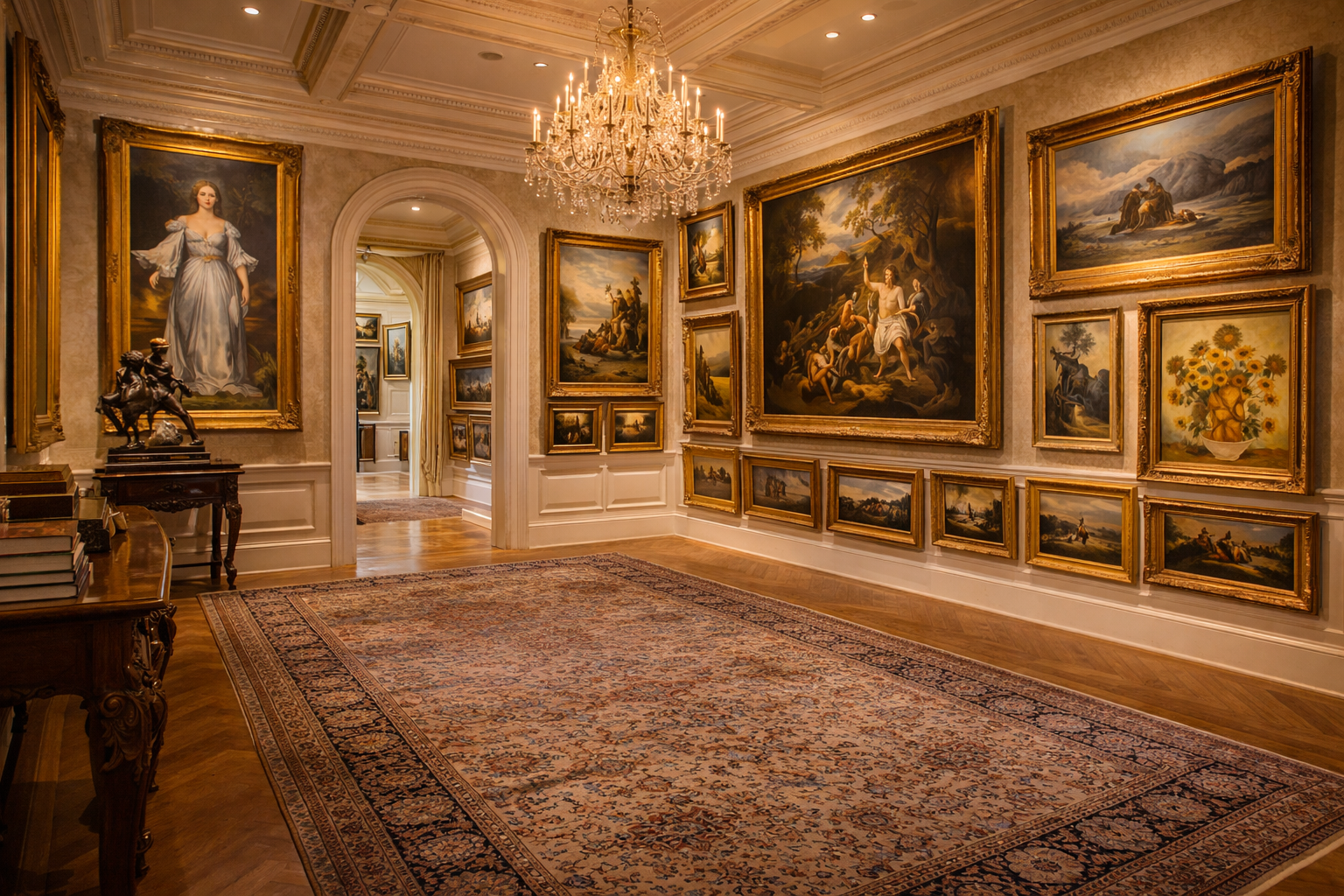
Collecting art is often described as an expression of taste. This is true at small scales. At larger ones, the relationship reverses. The collection ceases to express the individual, and the individual begins, quietly, to serve the collection.
Early collecting is intimate. Each acquisition reflects a personal encounter. A painting is remembered not only for its quality, but for the moment of discovery, the hesitation before purchase, the quiet satisfaction of recognition. The collection forms slowly, like a portrait assembled over time. At this stage, ownership feels expressive. The works belong to the collector.
At a certain point, however, the collection crosses a threshold. Not of value, but of mass. The number of works becomes large enough that they can no longer be held mentally as a whole. Memory gives way to inventory. The collection stops functioning as autobiography and begins functioning as archive.
The collector no longer recalls the cellar of works with confidence. They consult records. Software replaces memory. Inventory replaces intuition. The relationship becomes procedural. One no longer asks, “What do I feel like living with?” One asks, “What is appropriate to display?” Taste gives way to administration.
Once the collection reaches institutional scale, it begins to generate its own gravitational field. New acquisitions are no longer evaluated primarily by affection. They are evaluated by fit. Does this artist complete a period? Does this piece strengthen a category? Does it balance a weakness in the holdings? The language shifts from desire to coverage. The collection develops needs. The collector becomes its custodian.
This is not vulgar excess. It is structural transformation. The collection has become larger than the personality that initiated it.
At this point, the owner experiences a subtle displacement. Guests no longer ask what one likes. They ask what one owns. The individual is no longer encountered as a person with taste, but as a location. One becomes a site. Conversations orbit the holdings rather than the self. Identity compresses around possession.
The danger is not that the collection becomes too large. It is that it becomes too authoritative. It begins to speak more loudly than its owner. The person becomes an appendix to the holdings.
This process accelerates when the collection becomes public-facing. Lenders, curators, and advisors enter the picture. The owner’s role shifts again. They are no longer merely a collector, they are a stakeholder in a cultural apparatus. Works are chosen for coherence, reputation, historical position. The collection acquires obligations.
At this stage, role drift begins. The owner must live up to the collection. Their public identity is shaped by the expectations attached to their holdings. They are assumed to possess refined judgment even when their original taste may have been intuitive, inconsistent, or opportunistic. The collection projects a seriousness the individual must now maintain.
The works become more stable than the self. They persist. They appreciate. They accrue interpretation. The owner, by contrast, remains human. Interests change. Attention drifts. The collection does not drift. It accumulates weight.
This produces a quiet asymmetry. The personality must adapt to the collection, not the reverse. Spontaneity becomes dangerous. Casual opinions feel risky. One must now sound like the person such a collection should belong to. The individual becomes a representative of their own possessions.
What began as self-expression becomes self-discipline. The collector is no longer curating art. They are curating themselves.
Large collections inevitably outgrow the personalities that formed them. They become more consistent, more coherent, more legible than the individuals who assembled them. They develop a logic of their own. The owner remains complex. The collection becomes clean.
The paradox emerges. One acquires art to express identity. At scale, the art becomes the identity. The collector no longer has a collection. The collection has a collector.
This is not a tragedy. It is a structural consequence. Large systems replace small selves. Institutions absorb individuals.
The art collection, once personal, becomes architectural. It no longer tells a story about who one is. It tells a story about what one represents.
This is the quiet cost of successful collecting. Not that one has acquired too much art, but that the art has acquired the person.
Filed under: Distinction